Workflow Analysis in Healthcare: How Hospitals Streamline Operations

ScaleLabs helps ops-heavy B2B teams ship client portals and workflow automation that reduce email chaos, speed up onboarding, and improve visibility across the business.

Workflow analysis in healthcare is the process of studying how day-to-day tasks move across departments, from patient admission to discharge, to find inefficiencies and improve performance.
It’s about documenting who does what, when, and how. For instance, how long does it take for a lab order to move from the doctor’s request to the technician’s report, and then back into the patient record?
By mapping these steps visually, hospitals and clinics can identify where information gets delayed, duplicated, or lost. Typical healthcare workflows include:
- Clinical workflows: patient diagnosis, treatment planning, follow-ups.
- Administrative workflows: billing, insurance verification, and appointment scheduling.
- Operational workflows: inventory, supply chain, and staff scheduling.
A structured analysis provides the foundation for automating repetitive work, improving patient experiences, and giving medical staff more time for actual care.
Why Workflow Analysis Matters in Healthcare Operations
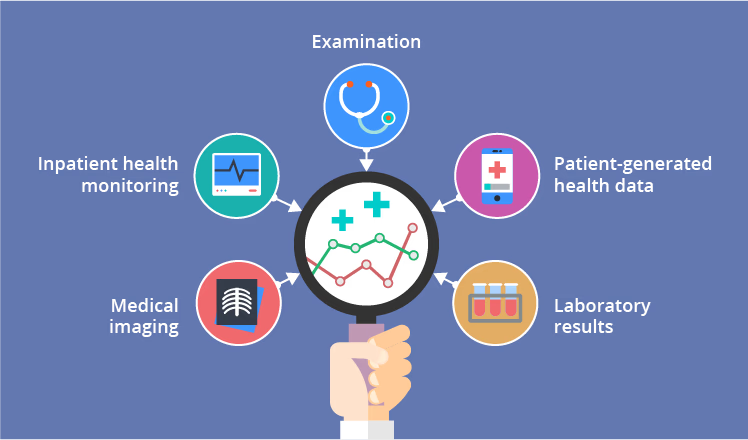
In healthcare, time and accuracy are everything. A single delay - say, a misplaced lab report - can impact diagnosis, increase patient stay, and lower satisfaction scores. Workflow analysis gives hospitals clarity on how work moves internally and how to make it smoother.
Here’s what it brings to the table:
- Faster patient care: Identifies redundant steps that slow down treatment.
- Better coordination: Helps clinical and non-clinical teams share information effectively, especially across EHR systems.
- Data-backed decisions: Reveals where resources are overused or underused.
- Cost control: Reduces administrative labor, paperwork, and rework.
- Improved compliance: Keeps documentation lifecycle management consistent and audit-ready.
For example, one U.S. clinic used workflow analysis to redesign its patient discharge process. The change cut average discharge time by 35 minutes per patient, freeing staff for more meaningful care and increasing daily throughput.
Steps in Conducting a Healthcare Workflow Analysis
A successful workflow analysis follows a structured process. Even a small clinic can use this framework without heavy technology investment.
Step 1: Identify the process to analyze: Pick a workflow that directly affects patient experience or efficiency, such as medication delivery, lab testing, or appointment scheduling.
Step 2: Observe and collect data: Watch staff in action and record the exact sequence of tasks. Use timestamps, screenshots, or simple notes. This helps you capture the real process, not the one written in manuals.
Step 3: Map the workflow: Create a visual diagram showing every digital handoff, from doctors to nurses to billing staff. Tools like Lucidchart or Miro work well here.
Step 4: Identify bottlenecks: Look for repeated steps, manual data entry, or long waiting times. For instance, if lab results are printed and re-uploaded, that’s a clear friction point.
Step 5: Redesign and test: Simplify where possible, automate alerts, combine duplicate forms, or introduce digital signatures. Then test the new process in a small department before full rollout.
Step 6: Measure results: Compare before-and-after performance metrics like patient wait time, error rate, or cost per case.
Example of Workflow Analysis in Healthcare

A strong example of workflow analysis in healthcare comes from a mid-sized hospital that was facing long patient discharge delays. Patients often waited more than two hours after being cleared for discharge, not because of medical issues, but due to paperwork, unclear handoffs, and manual approvals.
To find the cause, the hospital’s process improvement team mapped the entire discharge journey, from doctor clearance to final billing. They discovered several bottlenecks:
- Repeated data entry across EHR and billing systems.
- Paper-based doctor signatures caused time lags.
- Lack of visibility into pharmacy and admin clearance status.
The analysis showed that no single team was “causing” the delay; the problem was fragmented communication and outdated workflow design.
By digitizing the discharge process, the hospital replaced multiple emails and paper forms with a shared online dashboard. Here’s what changed:
- Automatic notifications alerted doctors when summaries were ready for sign-off.
- E-signatures replaced manual approvals.
- A centralized board displayed real-time discharge status across departments.
The results were striking.
Average discharge time dropped from 2.5 hours to under one hour, and the hospital was able to accommodate more patients each day without adding staff. Patient satisfaction scores rose, and nurses regained valuable time to focus on care rather than administration.
This example shows how workflow analysis doesn’t just improve efficiency; it directly impacts quality of care, staff morale, and operational capacity.
Tools and Methods for Workflow Analysis in Healthcare
Workflow analysis can be done with something as simple as a pen and paper or as advanced as process mining software. The choice depends on your scale; a small clinic might rely on manual observation, while a large hospital needs data-driven mapping.
Here are the most common methods used:
- Flowchart Mapping: Visual diagrams showing how information moves between people and systems. Tools like Lucidchart, Miro, or Microsoft Visio help map the entire process from patient intake to billing.
- Time–Motion Studies: Observing staff and measuring how long each task takes. These studies often reveal hidden bottlenecks, like waiting for approvals or unnecessary walk time between departments.
- EHR Audit Logs: Many electronic health record (EHR) systems track user activity. Analyzing these logs can show where data entry is delayed or repeated.
- Automation and Workflow Software: Platforms such as UiPath, Kissflow, or custom hospital dashboards (like the ones built by ScaleLabs) can automatically route documents, send alerts, and track progress in real time.
- Process Simulation: Some hospitals use simulation tools to test new workflows before implementing them, ensuring minimal disruption to patient services.
When combined, these methods give a complete picture, how work flows, where it slows down, and what can be automated safely.
Benefits of Optimized Healthcare Workflows
Improving workflows isn’t just about efficiency; it directly improves care outcomes, employee satisfaction, and financial performance.
Key benefits include:
- Shorter patient waiting times: Automated notifications and clearer handoffs prevent backlogs.
- Better communication: Doctors, nurses, and admins get shared visibility into task status.
- Fewer manual errors: Standardized forms and digital inputs reduce transcription mistakes.
- Higher staff morale: Nurses and technicians spend less time chasing approvals.
- Cost savings: Hospitals cut operational waste and improve resource utilization.
For example, a large urban hospital that streamlined its lab order workflow reported a 22% increase in test turnaround speed and reduced overtime hours by 18%.
In short, workflow optimization turns scattered, manual routines into connected systems that scale effortlessly, something every healthcare organization now needs.
How ScaleLabs Supports Healthcare Workflow Automation
At ScaleLabs, workflow analysis isn’t a one-time audit; it’s the foundation for continuous improvement. Our platform builds custom portals and dashboards that integrate with EHRs, CRM intergration for b2b, and internal databases, helping hospitals, clinics, and diagnostic centers automate:
- Task routing and approvals (e.g., discharge summaries or lab results).
- Document uploads and e-signatures.
- Real-time performance tracking via visual dashboards.
- AI-driven alerts for pending, overdue, or missing actions.
Instead of managing dozens of disconnected systems, teams get one unified view of how work moves, from patient admission to billing.
If your healthcare operations still rely on manual email chains or repetitive data entry, ScaleLabs can design a portal that automates your entire process securely and efficiently.
Contact ScaleLabs to explore how workflow automation can fit your healthcare environment.
Frequently Asked Questions
What is workflow analysis in healthcare, and why is it important?
Workflow analysis in healthcare helps hospitals and clinics understand how daily tasks are performed. Like patient registration, lab testing, and billing, actually happen. By mapping each step, teams can see where time is wasted, communication breaks down, or manual work causes delays. This insight allows them to redesign workflows that improve patient care and reduce operational costs.
How do hospitals typically conduct workflow analysis?
Most hospitals start by observing their teams in real-time, documenting how information flows from one department to another. They use tools like flowcharts, time-motion studies, and process mapping software to visualize it. Once bottlenecks are identified, new workflows are designed and tested, often supported by automation or dashboards that track progress across the system.
Can small healthcare facilities or clinics benefit from workflow analysis, too?
Definitely. Smaller clinics often face the same challenges as large hospitals: paperwork duplication, long waiting times, and slow coordination. Even a simple workflow analysis using spreadsheets or free diagramming tools can make a big difference by helping teams spot redundant tasks and improve communication between front-desk staff and physicians.
What are some common challenges found during workflow analysis in healthcare?
Typical challenges include unclear role assignments, reliance on paper-based approvals, and limited visibility into task status. Many hospitals also find that their EHR systems don’t integrate smoothly with billing or pharmacy platforms. Workflow analysis exposes these gaps, allowing organizations to introduce automation and better information sharing.
How does workflow automation improve patient outcomes?
Automation cuts down repetitive work, such as sending reminders or verifying forms, allowing staff to spend more time on patient interaction. It ensures that critical updates, lab results, discharge summaries, and medication alerts reach the right people instantly. Faster communication and fewer errors naturally translate into safer, more personalized patient care.