AI Invoice Automation for Construction Teams: Smarter, Faster, More Accurate

ScaleLabs helps ops-heavy B2B teams ship client portals and workflow automation that reduce email chaos, speed up onboarding, and improve visibility across the business.

In construction, invoices don’t just reflect payments - they represent project momentum. Every purchase order, subcontractor bill, and delivery slip must be linked to the correct job code, cost center, and company branch.
Now multiply that by 1,500+ invoices a month across dozens of active projects. And you begin to see the scale of chaos.
For many firms, accounting teams still manually open each invoice excel sheet, email, identify the job, and forward it to the right manager. The result? Endless back-and-forth emails, delayed approvals, and tight monthly cut-offs that leave teams working late just to stay on schedule.
The real cost isn’t just time; it’s accuracy. One incorrect billing entity or job code can delay payment cycles, distort project budgets, and even risk compliance issues.
“We have invoices coming in to the wrong company all the time,” shared a construction executive. “Our team spends hours redirecting them before anyone can even start processing.”
Why it matters: As deadlines tighten and project counts grow, these manual steps become unsustainable. Automating invoice handling isn’t just about saving time; it’s about maintaining operational control.
Where the Bottleneck Begins
Most construction firms already use ERP and approval software like Sage 300 or TimberScan, which manage the later stages of invoice processing, coding, review, and approval. But the real slowdown happens before the invoice even reaches those systems.
Here’s what the typical process looks like:
- Vendor emails an invoice to a shared inbox (e.g., ap@company.com).
- A team member manually opens it, determines which project it belongs to, and forwards it to the relevant manager.
- The manager checks formatting, PO number, and job details.
- If anything’s missing, the invoice is emailed back to the vendor for correction, starting another round of follow-ups.
For large general contractors managing multiple subsidiaries, even small mistakes, like billing “Peak Construction” instead of “Peak Construction U.S. Ltd.”, trigger manual intervention.
This cycle repeats hundreds of times every month. Even if only 5–10% of invoices need rework, that’s 75–150 manual corrections per cycle.
It’s not a software issue; it’s a workflow issue. The gap sits between the inbox and the ERP. That is why it is important to automate your workflows with AI.
The Case for AI-Driven Invoice Intake
AI invoice intake fixes the exact part of the process that humans find most repetitive: reading, sorting, and validating incoming invoices.
With the right system in place, here’s how it works:
- AI scans incoming invoices directly from the email inbox.
- It extracts and validates critical data like vendor name, company, project code, and PO.
- If information is missing or incorrect, the system auto-replies to the vendor with a polite message (e.g., “Your invoice is missing a PO number. Please update and resend.”).
- Only valid, complete invoices are pushed to TimberScan for human approval.
Instead of manually checking every email, your team now supervises exceptions, reviewing only the invoices flagged by AI.
This is where automation delivers exponential value: it cuts out 80% of redundant steps without removing human oversight.
It’s not replacing people, it’s reassigning their focus.
“We’re not looking to remove the human element,” one project director explained.
“We just need the system to catch errors before they reach us.”
The outcome?
- Faster invoice turnaround
- Fewer missed deadlines
- More accurate data feeding into Sage or ERP systems
In short, AI doesn’t change how accounting works; it just changes how fast and cleanly it starts.
Keeping the Human in the Loop

AI should assist, not approve.
That’s the mindset successful construction firms are adopting as they bring automation into their accounting and project management workflows. That’s the mindset successful construction firms are adopting as they bring accounting client portal automation into their accounting and project management workflows.
In this process, AI acts as the gatekeeper, not the decision-maker. It receives invoices, checks them for completeness, and routes them correctly. But the ultimate decision still lies with humans, especially when context matters, such as verifying project progress or confirming work completion before payment.
For example:
- AI can confirm that an invoice belongs to the “Surrey Tower Project” and includes the right PO number.
- But it can’t verify whether 55% of the work has been done when a subcontractor bills for 75%. That decision must come from a project manager.
That’s why the best systems are built with “human-in-the-loop” logic, automation that takes care of what’s predictable while leaving control in the hands of the team.
This balance prevents automation errors, keeps audits clean, and ensures that AI remains a reliable assistant, not a risky shortcut.
“We’re not aiming for cradle-to-grave AI,” said one construction executive. “It should clean and classify data, but the approvals stay human.”
At ScaleLabs, this is exactly how we approach automation: let machines handle the mechanical work, and humans handle the meaningful work.
Why Now: Tight Deadlines and Competitive Edge
For many construction teams, invoicing isn’t just paperwork; it’s a race against time. Invoices typically have to be received by the 20th of each month, validated, coded, and approved by multiple managers, and then rolled up into progress claim reports by the 26th.
If that window overlaps with a weekend or public holiday, accounting teams lose valuable days and face intense pressure to catch up.
This is when mistakes happen, wrong cost codes, delayed entries, missing attachments — and those errors can delay payments from project owners.
In construction, late invoicing doesn’t just affect accounting; it disrupts the entire cash flow chain.
That’s why automation isn’t just a convenience anymore. It’s a competitive advantage. Companies that streamline their invoice workflows can process faster, reduce end-of-month stress, and maintain accuracy even during peak load periods.
And as one executive pointed out, “If other construction firms in our market start automating and we don’t, we’ll be spending more on admin just to keep up.”
It’s not about replacing people. It’s about freeing them from the repetitive grind so they can focus on exceptions, strategy, and decision-making, the things that actually move the project forward.
The Gateway to Scalable AI Adoption
Accounting is often the first safe step into AI for construction companies — what one executive called “a gateway drug to AI.”
It’s measurable, low-risk, and easy to compare against the old manual process. You can literally track before-and-after results:
This creates immediate ROI, not just in cost savings, but also in employee morale and accuracy. When teams spend less time chasing invoices and more time analyzing data, it lifts productivity across the board.
And once companies see that AI can work safely within their accounting process, it opens doors to bigger opportunities:
- Estimating assistance: scanning blueprints to auto-generate scopes of work.
- Material forecasting: predicting when to order supplies based on project progress.
- Document routing: automatically filing inspection reports, change orders, or RFIs.
The lesson? Start with one process, prove it works, and scale from there.
The Future: Vendor Portals That Learn
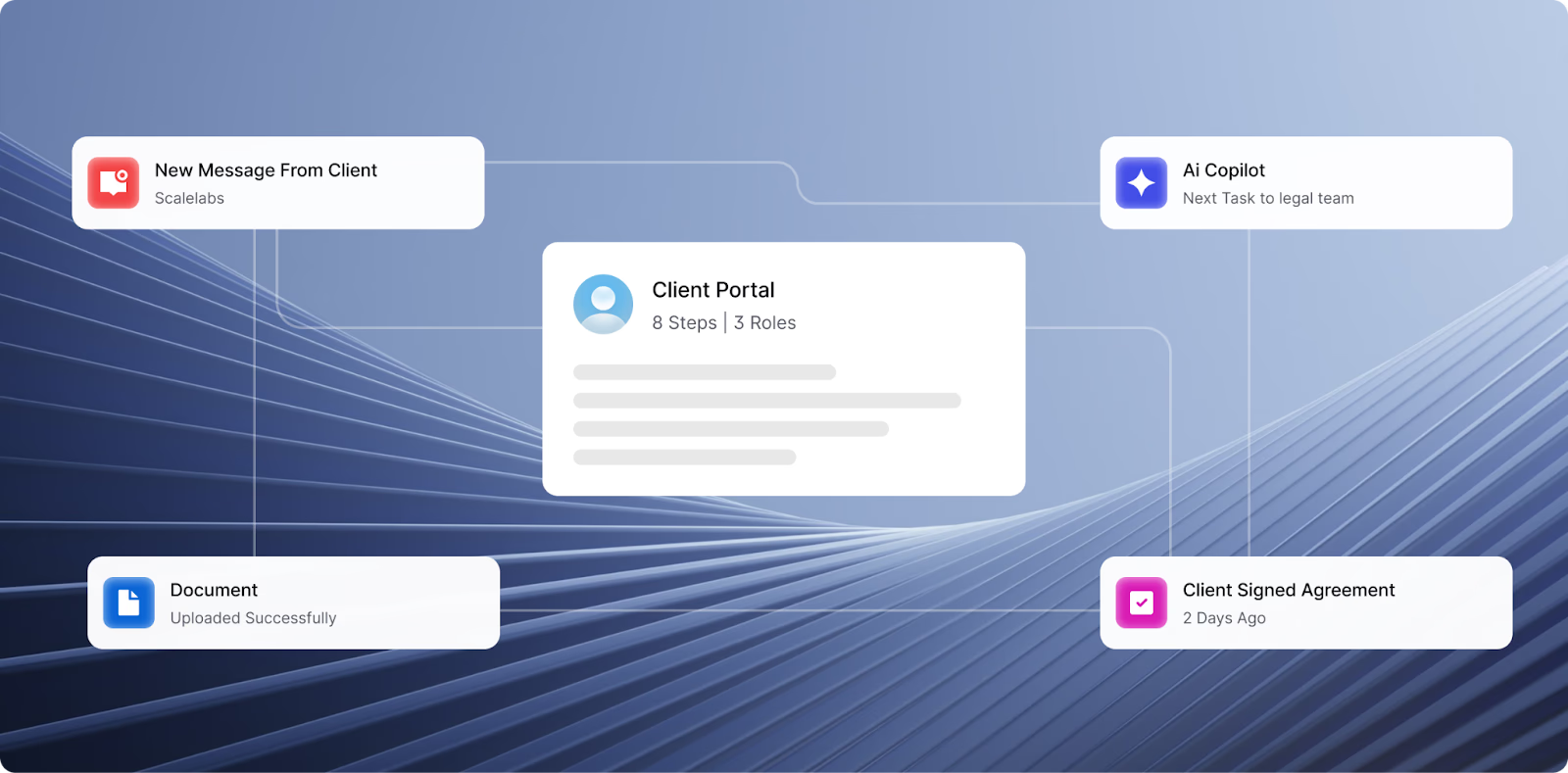
Imagine an environment where vendors no longer send invoices to an inbox; they upload them directly into a secure AI-powered vendor portal.
The system instantly verifies details, checks compliance fields, and routes approved invoices straight into TimberScan or Sage. No email threads. No “wrong company” errors. No waiting for someone to forward attachments.
Vendors can log in anytime to check status updates:
- Approved
- Pending Review
- Needs Correction
Meanwhile, your project managers get real-time visibility into every invoice tied to their job, reducing the daily “Did you get my invoice?” calls. In one use case, a contractor saw a 70% reduction in email volume once vendors started using an integrated portal. And it’s not just accounting that benefits. Once vendors and subcontractors get used to interacting through a portal, the same structure can be extended to:
- Submittals and approvals
- Compliance document uploads
- Progress reporting and job photos
This is where ScaleLabs steps in, building custom vendor and client portals that evolve with your needs. From invoice automation to workflow intelligence, we help companies bridge the gap between manual systems and modern, connected operations.
If you’re still relying on inbox sorting and manual forwarding, you’re spending valuable hours on what AI can do in seconds. At ScaleLabs, we help construction teams cut invoice chaos, eliminate email loops, and connect directly to their ERP.
👉 Talk to ScaleLabs about automating your invoice intake, and take your first step toward smarter, AI-driven operations.