
How a Multi Divisional Manufacturing Company Reduced $720K in Operational Waste by Fixing Fragmented Systems
Overview
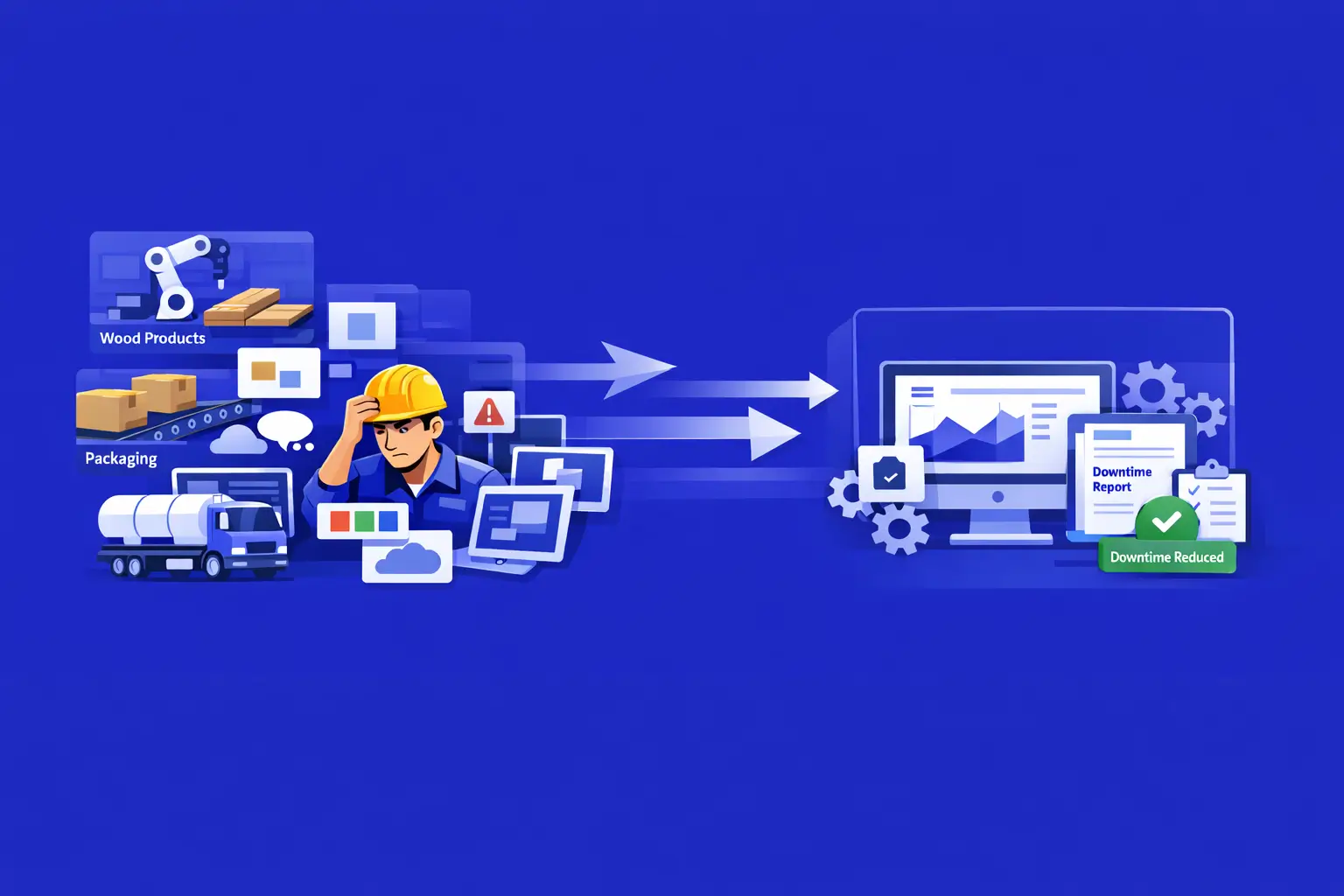
A mid market company operating across wood products, packaging, and bulk transport had reached a critical stage in its growth.
With approximately 220 employees, including 60 office staff, the business was expanding at nearly 20% year over year. Growth was no longer the challenge coordination was.
Different divisions had evolved independently over time. Each team adopted its own tools, processes, and documentation practices. What initially enabled agility began to create friction as the company scaled.
The Challenge: Growth Without Operational Structure
As the company expanded into multiple divisions and remote plant operations, the lack of a unified operational system became increasingly visible. The problems were not isolated, they were interconnected.
Fragmented Information Across Systems
Operational knowledge was distributed across five different storage locations and more than 16 software platforms. These included Microsoft Teams, shared drives, internal tools, ERP systems, and standalone documentation.
There was no single place to access information, and more importantly, no way to search across systems.
Employees often had to rely on other people instead of automated systems. It was common for staff to ask multiple colleagues just to locate a document or piece of information.
Over time, this created a measurable impact:
- Office staff were spending up to 2 hours per day searching for information
- Knowledge remained trapped with individuals instead of systems
- Decision making slowed down due to lack of access to reliable data
Downtime Reporting Without Actionable Data
Production issues were being reported, but not in a usable format.
Operators would log downtime events using vague descriptions such as:
- “The bags were bursting”
- “The machine stopped”
These reports lacked the detail required for root cause analysis. Engineers reviewing the reports could not determine:
- What exactly happened
- At which stage it occurred
- What conditions led to the issue
As a result, troubleshooting became reactive. Problems were often investigated after the fact, sometimes requiring site visits because the issue could not be reproduced remotely.
This led to:
- Delayed resolution cycles
- Repeated issues with no clear pattern
- Estimated $100,000 annual loss due to preventable downtime
Technical Documentation Was Not Usable in Practice
The company operated complex machinery, including hydraulic systems and heavy equipment. Each system came with extensive technical documentation often hundreds of pages long.
In practice, these manuals were difficult to use:
- Information was spread across multiple documents
- Terminology varied between manufacturers
- There was no indexing or search capability
Even experienced engineers faced difficulty locating specific instructions during troubleshooting. The issue was not a lack of documentation, it was the inability to retrieve the right information at the right time.
Disconnected Systems Across Business Units
Each division within the company operated with its own software stack. Dispatch, packaging, repair, and retail teams used different systems that did not communicate with each other.
This created:
- Data silos across departments
- Inconsistent reporting formats
- No unified view of operations
Even though data existed, it could not be consolidated into actionable insights.
Adoption Risk from Previous Software Failures
The company had already experienced failed software implementations. Tools that were introduced with good intent were ultimately not used because:
- The user experience was poor
- Outputs were unreliable
- AI Workflows did not match real world usage
There was strong internal awareness that:
If the system is not trusted, it will not be used regardless of how advanced it is.
This made adoption a critical factor in any new implementation.
The Solution: Structuring Operations Before Automating Them

Instead of introducing another disconnected tool, the approach focused on structuring how information flows across the organization.
The solution was designed around three key principles:
- Centralize access to information
- Standardize how data is captured
- Enable retrieval without increasing complexity
Centralized Knowledge and Documentation Layer
All operational documentation was consolidated into a single structured system. This included:
- SOPs
- Technical manuals
- Internal guides
- Process documentation
Instead of forcing users to navigate multiple platforms, the system enabled search across all documentation sources from one interface.
This significantly reduced reliance on internal knowledge holders and improved accessibility for new and existing employees.
Structured Downtime Reporting
A new reporting system replaced free-text inputs with guided data capture.
Operators were prompted to provide:
- Context of the issue
- Stage of occurrence
- Observed conditions
- Relevant operational details
Additionally, field reporting was simplified using voice-to-text input, allowing technicians to document issues without interrupting their workflow.
This resulted in:
- More consistent reporting
- Better data quality
- Faster root cause analysis
Improved Troubleshooting Workflow
Instead of manually scanning documentation, technicians could retrieve relevant information based on the issue they were facing.
The system enabled:
- Faster identification of required steps
- Reduced dependency on senior engineers
- Consistent troubleshooting approaches across teams
This was particularly valuable in remote plant operations, where immediate support was not always available.
Integration with Existing Systems
The solution was designed to work within the company’s existing ecosystem, including:
- Microsoft Teams
- Microsoft Dynamics Business Central
- Internal operational tools
This minimized disruption and reduced the learning curve for employees.
Controlled Automation with Human Oversight
Automation was introduced selectively, with clear boundaries.
For sensitive processes such as billing and approvals:
- Human validation remained in place
- Automation supported decision-making rather than replacing it
This ensured accuracy while building trust in the system.
Implementation Approach
The rollout was structured in phases to ensure stability and adoption.
Phase 1: Foundation (0–3 Months)
- Mapping core workflows
- Consolidating documentation
- Deploying centralized search capabilities
- Introducing structured reporting
Phase 2: Expansion (3–6 Months)
- Extending to remote plant operations
- Integrating additional systems
- Enhancing reporting and analytics
- Standardizing onboarding processes
Initial deployment focused on high-impact areas, including packaging operations and selected remote sites.
Results: Measurable Improvements Across Operations
The impact of the implementation was measurable within months.
Efficiency Improvements
- Daily information search time reduced from 2 hours to 0.4 hours
- Reduced dependency on internal communication for basic information
Cost Reduction
- Annual productivity loss reduced from $720,000 to $144,000
- Additional $50,000 savings from reduced downtime
Operational Gains
- Faster troubleshooting with fewer escalations
- Improved quality of downtime reporting
- Reduced need for on-site intervention
Organizational Impact
- Faster onboarding for new employees
- Improved cross team alignment
- Better visibility into operational performance
Key Takeaways
This case reflects a common challenge in scaling organizations: growth introduces complexity faster than systems can adapt and the company did not lack tools. It had too many without structure.
By focusing on:
- Consolidation
- Standardization
- Controlled automation
The business was able to reduce inefficiencies and build a system that supports continued growth.