Why AI Can’t Replace Real Software Developers?

ScaleLabs helps ops-heavy B2B teams ship client portals and workflow automation that reduce email chaos, speed up onboarding, and improve visibility across the business.
Everyone in your industry is excited about AI. Some of your competitors are probably trying to use it to build software right now. Here's what they're not telling you about what happens next.
There's a question a lot of executives are asking behind closed doors right now: "Do I even need to hire developers anymore? Can't AI just build what I need?"
It's a fair question. AI tools can generate code. They can write a basic app in minutes. They look impressive in demos. But there's a critical difference between generating code and building software that actually runs your business — and that difference matters enormously when something goes wrong.
AI writes code. It doesn't understand your business.
A real developer sits down with you, asks hard questions, and pushes back when your idea doesn't make sense technically. They understand that your invoicing process is tied to your CRM, which is tied to your customer portal, which was built on a legacy system from 2014. They hold that context in their head for months and make hundreds of small decisions that protect your business every single day.
AI has none of that. It has no memory of your last conversation, no understanding of why your process works the way it does, and no accountability for what it produces.
"AI can generate code, but it doesn't fully understand the bigger picture — your business logic, your compliance requirements, your architecture."
Who's responsible when it breaks?
This is the question no one asks until it's too late. When an AI-generated system fails — and they do fail — there's no one on the other end of the phone. No one who can say "I built that, I know exactly what's wrong, I'll fix it tonight." You're left with a pile of code nobody fully understands and a business that's stopped working.
A professional developer is accountable. They own the outcome. That accountability is worth more than any tool that can spin up a prototype in 30 seconds.
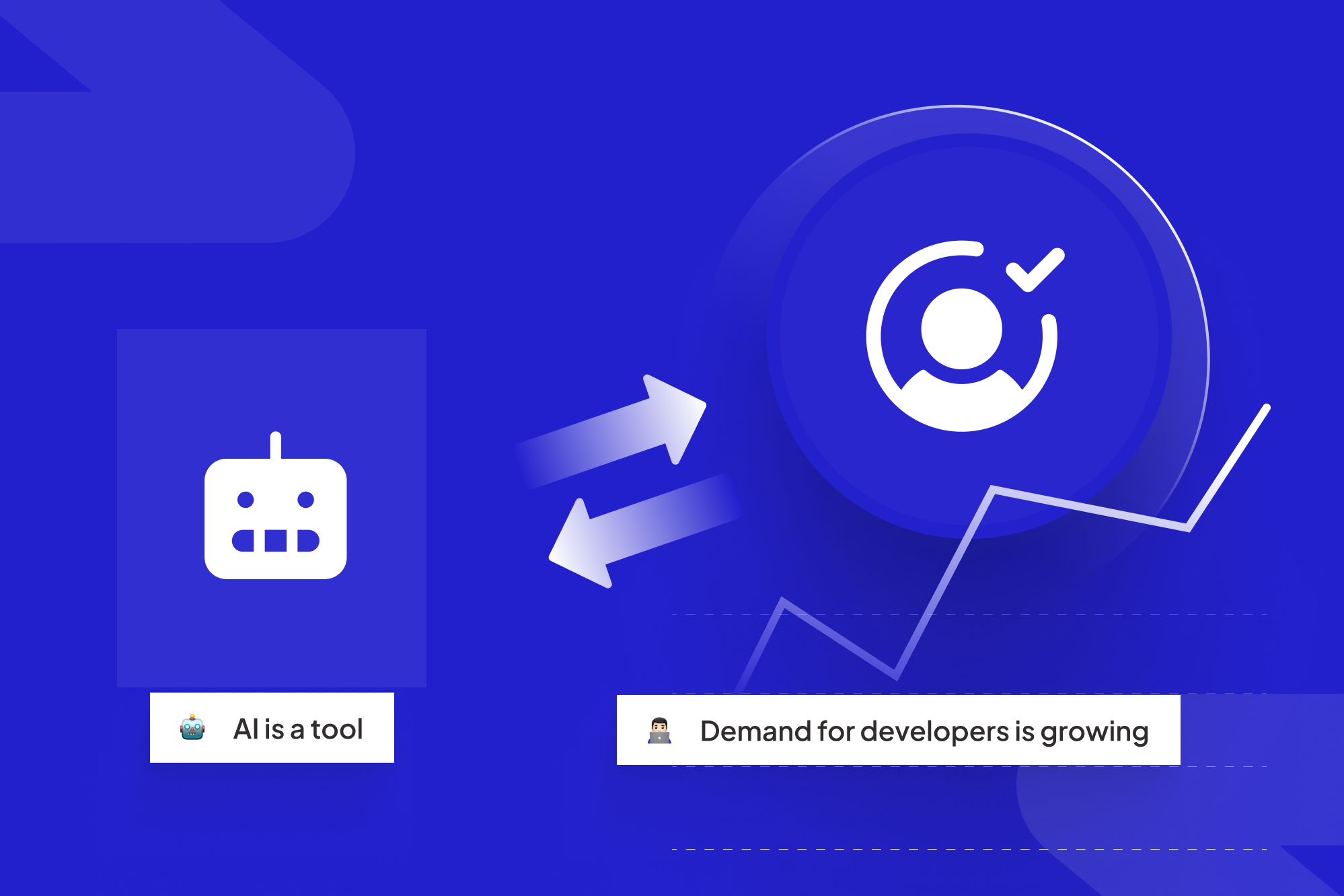
Stat: 80% of software engineers will need to upskill as AI reshapes their roles — but employment in the field is projected to grow 17.9% through 2033. AI is creating demand for *more* developers, not fewer. *(Gartner / U.S. Bureau of Labor Statistics)*
The real role of AI in software development
Here's the honest truth: AI is an extraordinary tool for developers. It helps them write faster, catch bugs earlier, and test more thoroughly. The best development teams in the world are using AI tools every single day — but they're using them as tools, not as replacements for the engineers who understand your business.
Think of it this way: a great architect uses software to design a building. But you wouldn't hand the software the keys and ask it to build the skyscraper unsupervised. The tool is only as good as the expert behind it.
What this means for your business
If you're a mid-size company making a serious investment in custom software, you need a developer who understands your goals, your constraints, and your future. You need someone who can look at your roadmap and tell you what's possible, what's risky, and what order to build things in. You need someone who will be there in six months when you need to change direction.
AI can't give you that. A skilled, accountable developer can.
Want to go deeper? We talk about this — real conversations about technology decisions that affect growing businesses. Search for us and take a look. If you want to talk through your specific situation, we're happy to have that conversation.